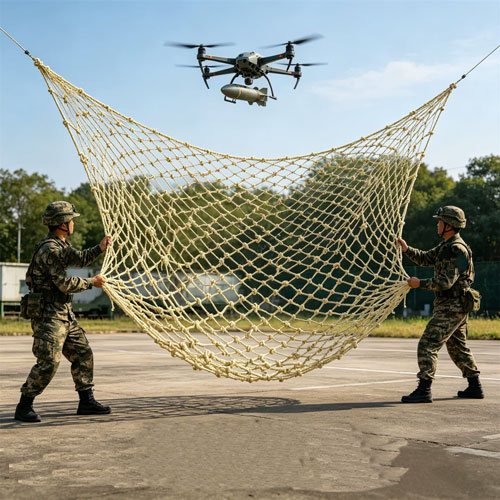
In 2026, a Ukrainian mortar team can buy a pop-up cricket batting net for less than the cost of a single 81 mm mortar bomb — and that net will stop an FPV drone carrying a grenade-sized warhead from killing the entire crew. This is not theory. This is not a concept paper. This is what is happening right now on the front lines of the most drone-intensive war in human history.
The question for anyone evaluating anti-drone nets — whether you are equipping a forward operating base, securing an airport perimeter, protecting a prison from contraband drops, or simply defending your property — is not whether nets work. The question is: which type of anti-drone net solution is right for your specific threat, environment, and budget?
This guide answers that question. You will find a structured comparison of the four major anti-drone net solution types, an industry-by-industry application breakdown, a direct comparison with electronic counter-drone technologies, a practical buyer checklist, and transparent cost guidance. All specifications are backed by ISO 9001:2015 certified manufacturing data.
What Is an Anti-Drone Net?
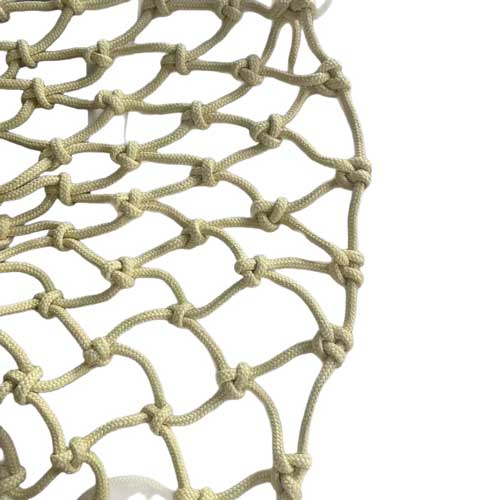
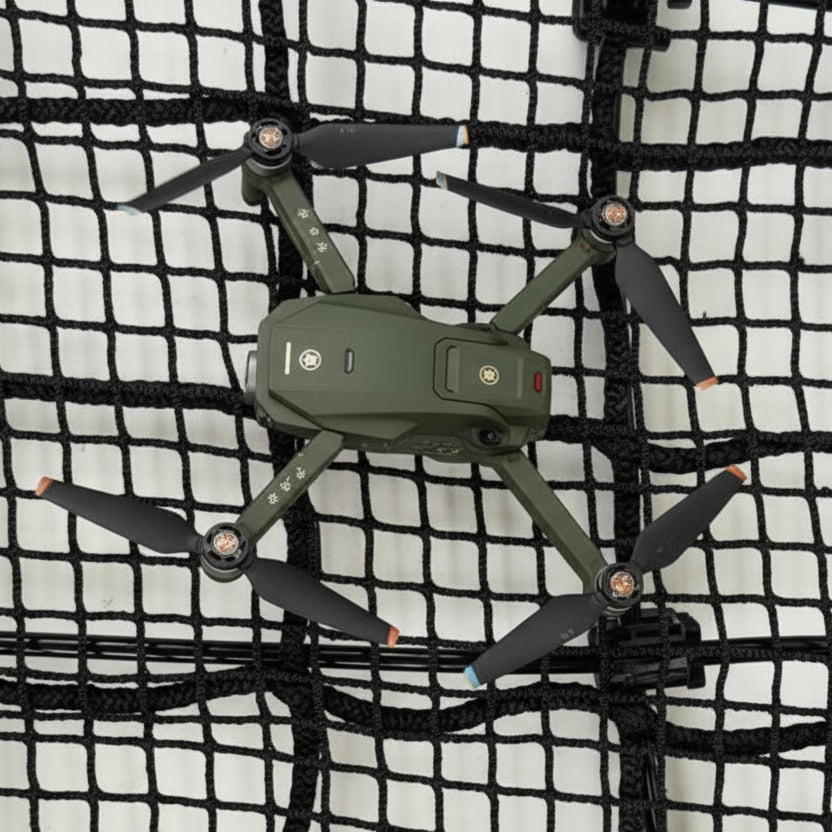
An anti-drone net is a physical barrier system engineered to intercept, entangle, and disable unmanned aerial vehicles before they reach a protected asset. The core mechanism is kinetic — exposed rotor blades catch the mesh fibers, the net wraps around the motor shafts, and the drone loses controlled flight within milliseconds. No jamming. No hacking. No electronic vulnerability.
But "anti-drone net" is not a single product. It is a category spanning four fundamentally different solution architectures, each with distinct engineering requirements, deployment methods, cost structures, and operational envelopes. Understanding the differences between them is the first step toward making an informed procurement decision.
This guide covers solution types — complete systems. For material-level specifications (aramid vs steel vs HDPE tensile strength, mesh aperture, UV resistance), see our anti-drone netting materials guide.
4 Types of Anti-Drone Net Solutions Compared
Anti-drone net solutions fall into four distinct categories. Each serves different threat profiles, deployment scenarios, and operational constraints. The table below provides a direct comparison across the six dimensions that matter most for procurement evaluation.
| Dimension | Fixed Perimeter Nets | Net Gun / Launcher | Overhead Canopy | Vehicle Cage |
|---|---|---|---|---|
| How It Works | Vertical net panels suspended between poles forming a continuous perimeter barrier | Compressed-air or pyrotechnic-launched net projectile that captures individual drones mid-flight | Horizontal or sloped netting suspended overhead to block drone descent and dive attacks | Net panels welded or bolted onto vehicle frames creating a standoff barrier around the hull |
| Threat Coverage | All drone types approaching at low-to-medium altitude from defined perimeter vectors | Single drones within 10-100 meter range; requires detection and targeting system | Dive-bombing FPV drones and munition drops from above; limited side protection | FPV attack drones, RPG-armed quadcopters, Lancet-class loitering munitions |
| Deployment Speed | Days to weeks — requires foundation engineering and pole installation | Seconds — handheld ready in under 3 seconds; vehicle-mounted under 10 seconds | Hours to days — requires overhead support frames or cable suspension | Hours — bolt-on or weld-on installation at depot or field workshop |
| Cost Level | Highest $$$$ | High $$$ per unit | Moderate $$ | Moderate $$ |
| Best Material | Stainless or galvanized steel for permanent; aramid for semi-permanent | Lightweight aramid or HTPE — projectile weight under 500g critical | HDPE or nylon for lightweight; aramid for high-threat | Steel mesh or chain-link for heavy; aramid for lightweight mobile |
| Ideal For | Airports, prisons, military bases, critical infrastructure | VIP protection, event security, police, rapid-response teams | Urban streets, motor pools, supply routes, building rooftops | Tanks, APCs, artillery, supply trucks, patrol vehicles |
Type 1 — Fixed Perimeter Net Barriers
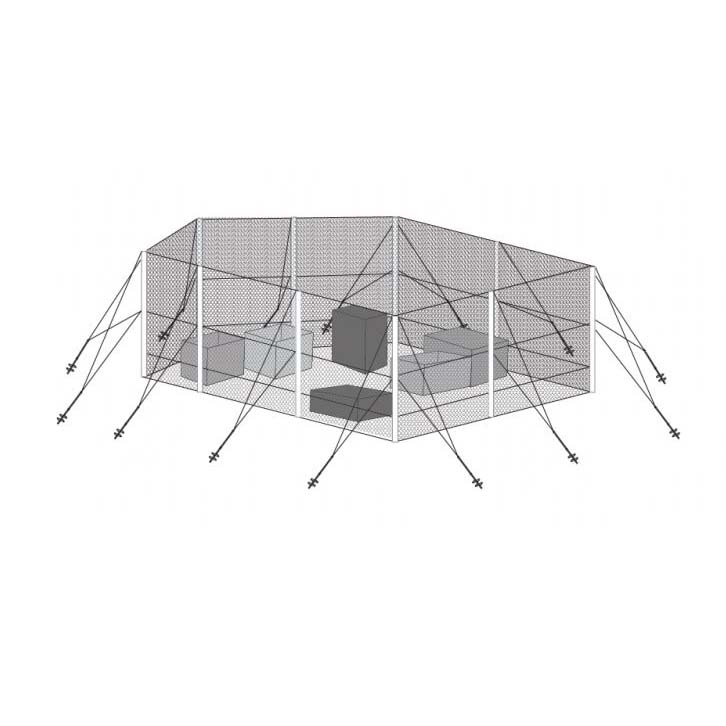
Fixed perimeter barriers are the most common and most heavily engineered anti-drone net solution. Vertical net panels — typically 4 to 12 meters in height — are suspended between steel or concrete poles spaced 5 to 10 meters apart, forming a continuous barrier wall around the protected perimeter. The system requires engineered foundations rated for regional wind loads. For heavyweight nets like stainless steel wire rope (4.5 kg/m2), foundations typically reach 1.5 to 2.0 meters in depth.
When to choose: Permanent installations where the protected asset does not move, budgets allow for civil engineering work, and the threat includes drones of all sizes approaching at low to medium altitude. Airports, military bases, prisons, and critical infrastructure sites are the primary applications. The anti-drone fence system provides integrated mounting hardware and tensioning that reduces engineering complexity for permanent installations.
When NOT to choose: Temporary deployments, mobile assets, budgets under $50,000 for complete installation.
Type 2 — Net Gun / Launched Capture Systems
Unlike passive fixed netting, net guns are active interception systems. A compressed-air canister or pyrotechnic charge propels a folded net toward the target drone at 40 to 80 meters per second. The net unfolds mid-flight to a capture diameter of 3 to 5 meters. Upon contact, it wraps around the drone and entangles the rotors. Handheld units weigh 4 to 8 kg loaded and can be readied for firing in under 3 seconds.
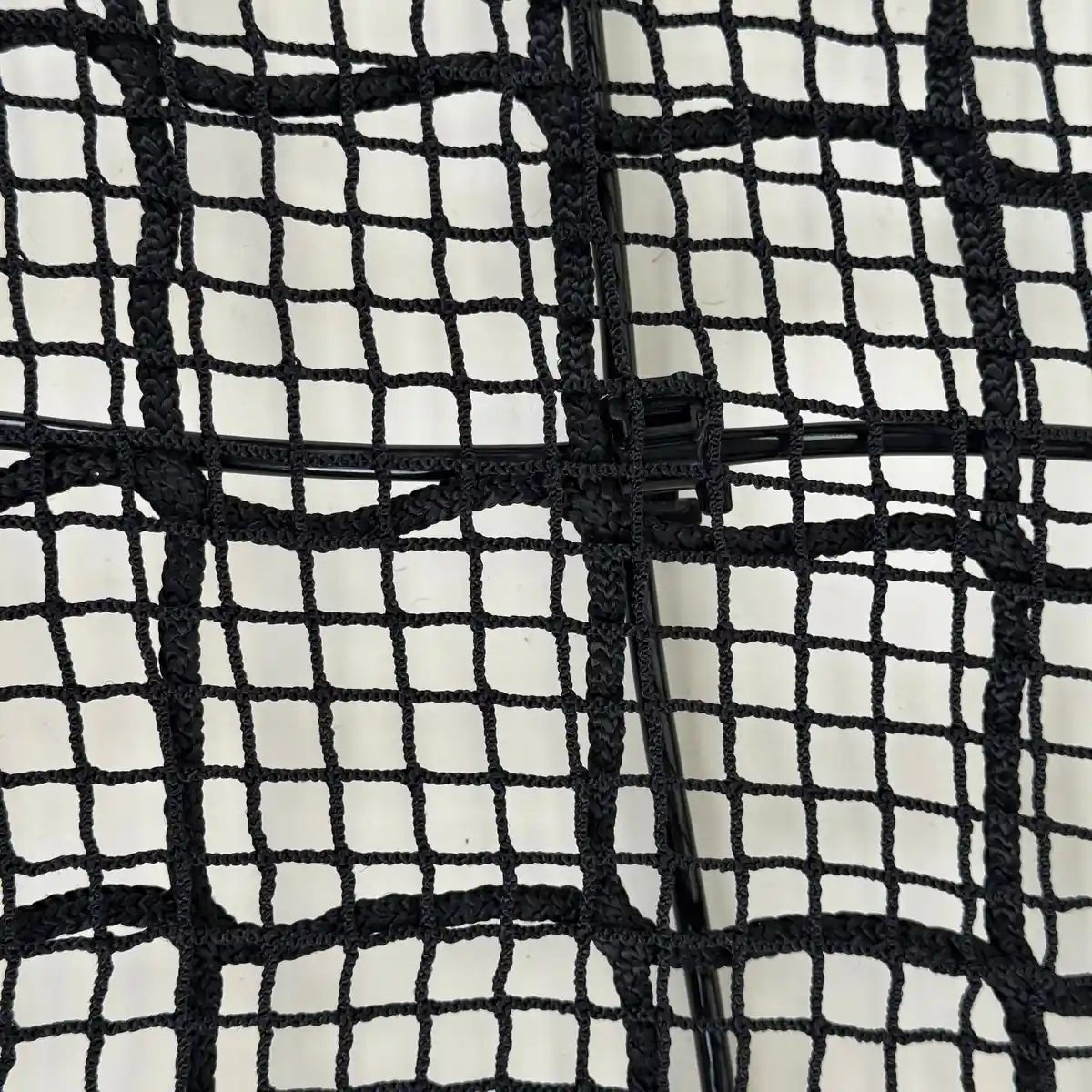
The critical engineering constraint is projectile weight: the entire assembly — net, corner weights, and deployment mechanism — must stay under 500 grams for handheld launchers. This demands lightweight materials. Aramid fiber nets at 200 to 400 g/m2 are the standard, providing adequate tensile strength at minimal mass.
When to choose: Mobile security details, VIP protection, event security, law enforcement, and scenarios where you need to intercept individual identified drones rather than create a continuous barrier. Effective engagement range: 10 to 100 meters depending on the system.
When NOT to choose: Area protection against multiple simultaneous drones, 24/7 unattended protection, scenarios where detection and targeting infrastructure cannot be deployed.
Type 3 — Overhead Canopy Systems
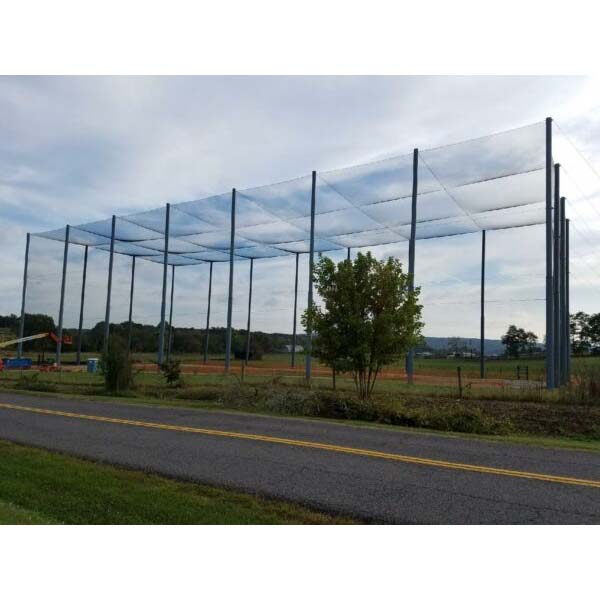
Overhead canopy systems suspend netting horizontally or at a slope above the protected area. This is the deployment type most visible in the Ukraine conflict, where entire city streets in Izium, Kramatorsk, and Kherson now run through continuous tunnels of white nylon netting. The Ukrainian government plans to deploy approximately 4,000 kilometers of overhead drone netting along supply routes by the end of 2026, with teams capable of installing roughly 12 km per day.
The dominant engineering concern is wind uplift rather than dead load — the net acts as a sail in high winds, requiring robust cable suspension and anchoring systems. For lightweight nets (HDPE at 180-350 g/m2 or nylon at similar weights), existing streetlight poles, buildings, and lightweight frames can serve as support structures. For heavier aramid or steel nets, dedicated support frames are required.
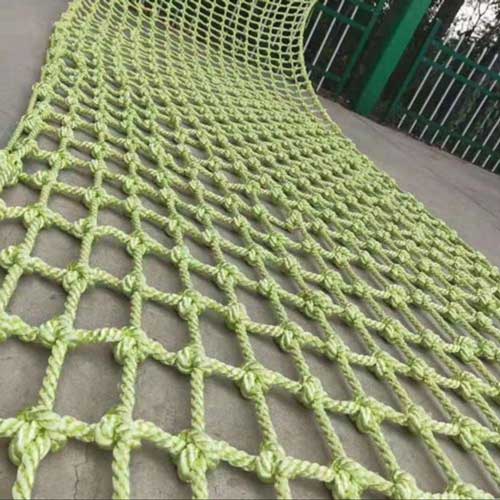
When to choose: Protection against dive-bombing FPV drones and munition drops from above. Urban streets, motor pools, vehicle staging areas, supply convoy parking, and building rooftops. The most cost-effective solution for large-area overhead coverage.
When NOT to choose: Scenarios where side-angle drone approaches are the primary threat — overhead canopies provide limited lateral protection. Sites where overhead support structures cannot be installed.
Type 4 — Vehicle-Mounted Cage Systems
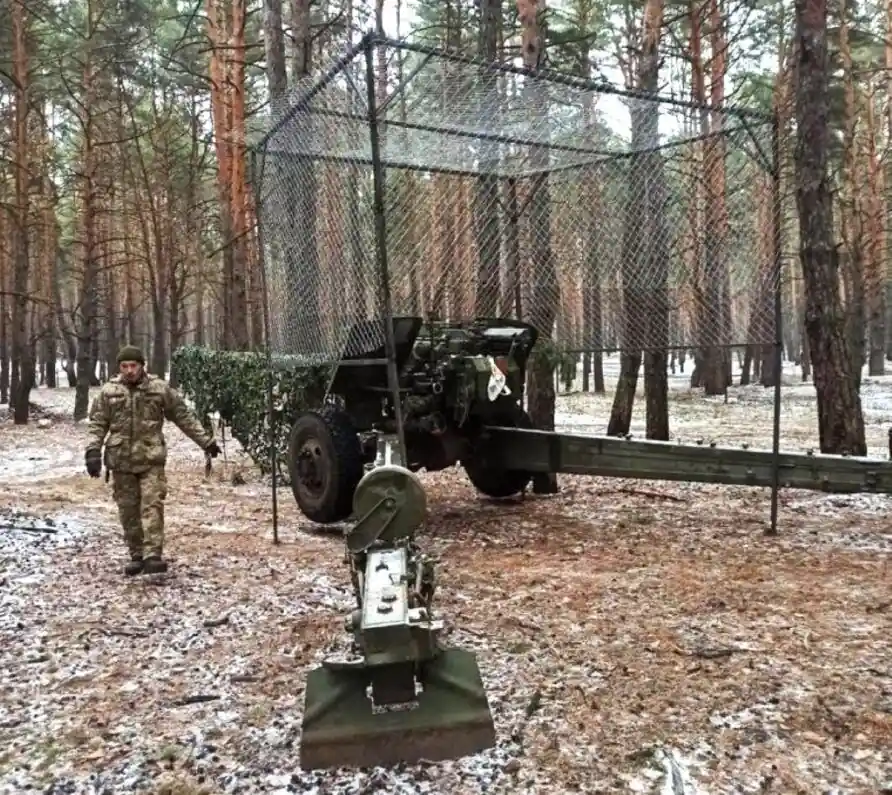
Vehicle-mounted anti-drone cages — widely known as "cope cages" from their rapid proliferation in the Russo-Ukrainian war — consist of net panels or metal mesh structures welded or bolted directly onto military vehicles. The defeat mechanism differs from entanglement: for larger loitering munitions like the Russian Lancet (12 kg, 3 kg warhead), the cage is designed to cause premature detonation of the shaped-charge warhead at a standoff distance from the vehicle hull, preventing the plasma jet from penetrating the armor.
The effectiveness of vehicle cages depends critically on standoff distance. Too close to the hull, and the warhead still defeats the armor. Too far, and the cage becomes unwieldy, increases the vehicle silhouette, and interferes with turret traverse, sensor arcs, and crew ingress/egress. Optimal standoff distances are typically 30 to 80 cm, determined empirically through testing rather than pure calculation due to the complex interaction between warhead geometry, cage mesh pattern, and detonation timing.
Multiple NATO member states have initiated formal evaluation programs: the British Defence Ministry began trials of anti-drone cages on Challenger 2 tanks in January 2025; Japan released imagery of Type 90 and Type 10 tanks with anti-drone netting in May 2025; India and China have deployed similar solutions on their armored fleets. What began as improvised battlefield modification is now being integrated into formal military procurement specifications.
When to choose: Military armored vehicles operating in FPV-drone-saturated environments. Provides protection during movement and at the halt. Most effective as part of a layered defense combining detection, electronic warfare, and physical barriers.
When NOT to choose: Civilian vehicles, scenarios where vehicle weight and silhouette constraints are critical, environments where the primary threat is not drone-based.
Which Material for Which Solution Type?
Material selection is not independent of solution type — each deployment architecture imposes specific demands that make certain materials optimal and others impractical. Here is how to match material to solution.
| Material | Best For | Avoid For | Key Spec |
|---|---|---|---|
| Aramid (Para-Aramid 1414) | Net guns (lightweight), overhead canopies (high-threat), vehicle cages (mobile units), fixed perimeter (semi-permanent) | Permanent coastal installations without UV coating — UV degradation reduces lifespan below 5 years without protective treatment | 3,500 N/strand, 280 g/m2 |
| Stainless Steel (AISI 304/316) | Fixed perimeter (permanent, all environments), overhead frames | Net guns — too heavy; vehicle cages — adds excessive weight; temporary deployments — installation cost too high | 1,800 N/mm2, 4.5 kg/m2 |
| HDPE (UV-stabilized) | Overhead canopy (budget), fixed perimeter (lightweight), residential applications | Military vehicle cages — inadequate tensile for Lancet-class; high-security perimeters — low cutting resistance | 35 kN/m, 180-350 g/m2 |
| Galvanized Steel (HDG) | Fixed perimeter (inland, budget-sensitive), vehicle cages (heavy armor) | Coastal installations — 5-8 year max; overhead canopy — excessive weight; net guns — impossible | 1,500 N/mm2, zinc 610 g/m2 |
The critical procurement insight: material cost dominates the per-square-meter price, but installation cost often dominates the total project budget. Aramid at $15-35/m2 looks 3-5x more expensive than HDPE at $2-8/m2 — but aramid weighs 280 g/m2 vs HDPE at 180-350 g/m2, meaning both can use the same lightweight support structures. Stainless steel at 4.5 kg/m2 requires foundations that cost 2-3x the material itself. For many projects, aramid is cheaper in total installed cost than HDPE once poles and foundations are factored in — a counterintuitive result that surprises first-time buyers. For a complete material specifications breakdown including tensile testing standards, UV aging data, and environmental performance curves, see our dedicated anti-drone netting materials guide.
Anti-Drone Net Applications by Industry
Think Defence's excellent analysis of counter-drone nets covers military tactical scenarios in extraordinary depth — dismounted infantry patrols, battle trenches, vehicle hides, and urban defensive positions. This section complements that analysis by covering the full spectrum of industry applications that military-focused content ignores.
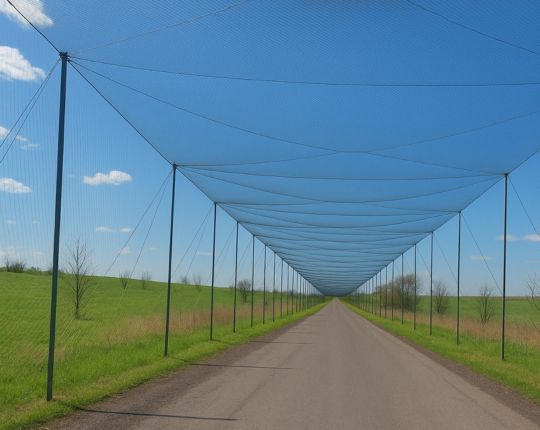
Military & Defense
Forward operating bases, vehicle armor, artillery positions, supply convoys, field hospitals. All four solution types are in active use. Deployment guide →
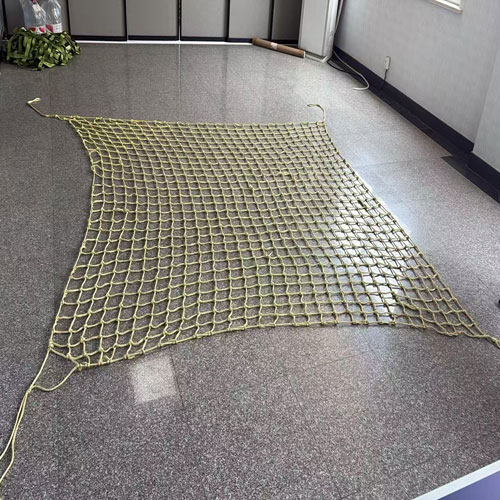
Airports & Aviation
Runway approaches, terminal perimeters, fuel storage, hangars. Active jamming is prohibited near navigational equipment — passive nets are often the only viable 24/7 option.
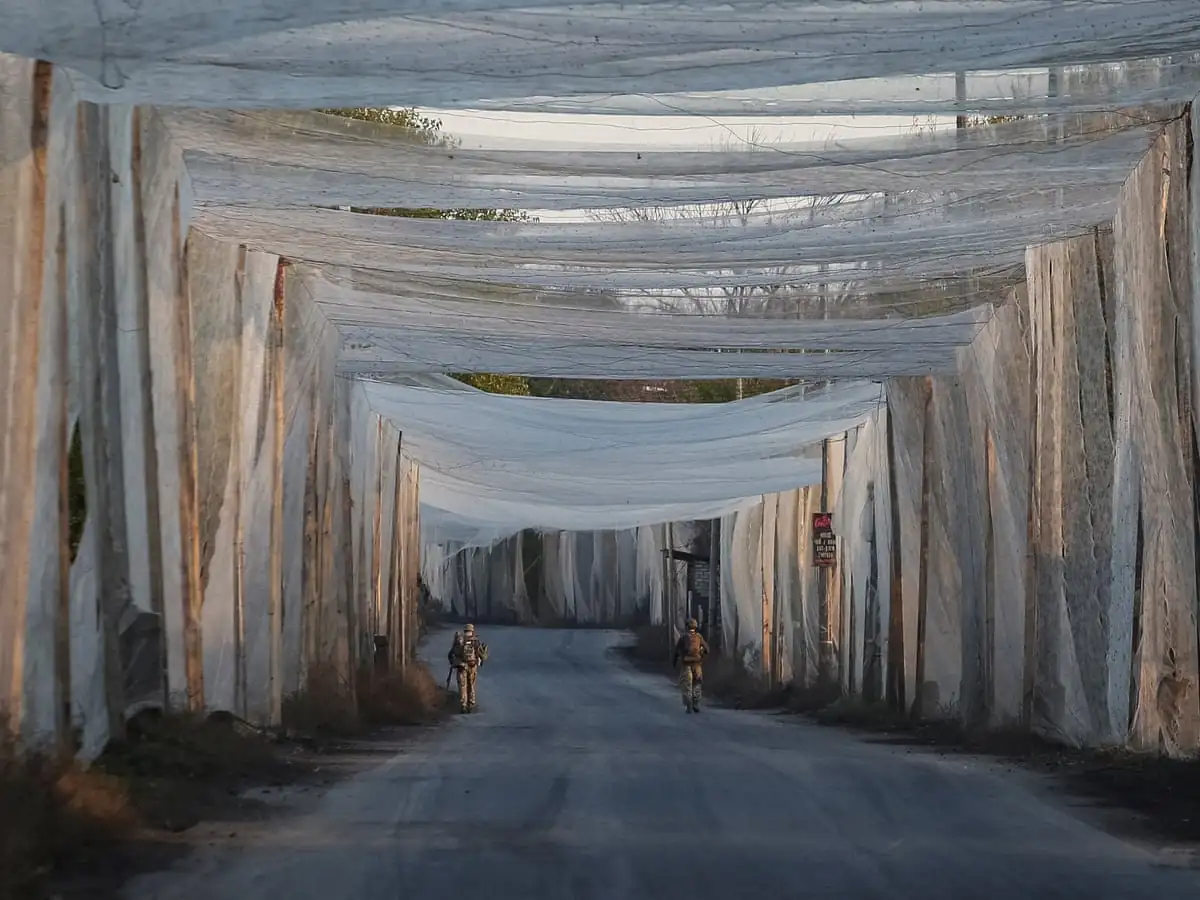
Prisons & Corrections
Perimeter contraband interdiction — drones are now the primary smuggling method for phones, drugs, and weapons. Fixed nets + overhead canopies. Prison guide →
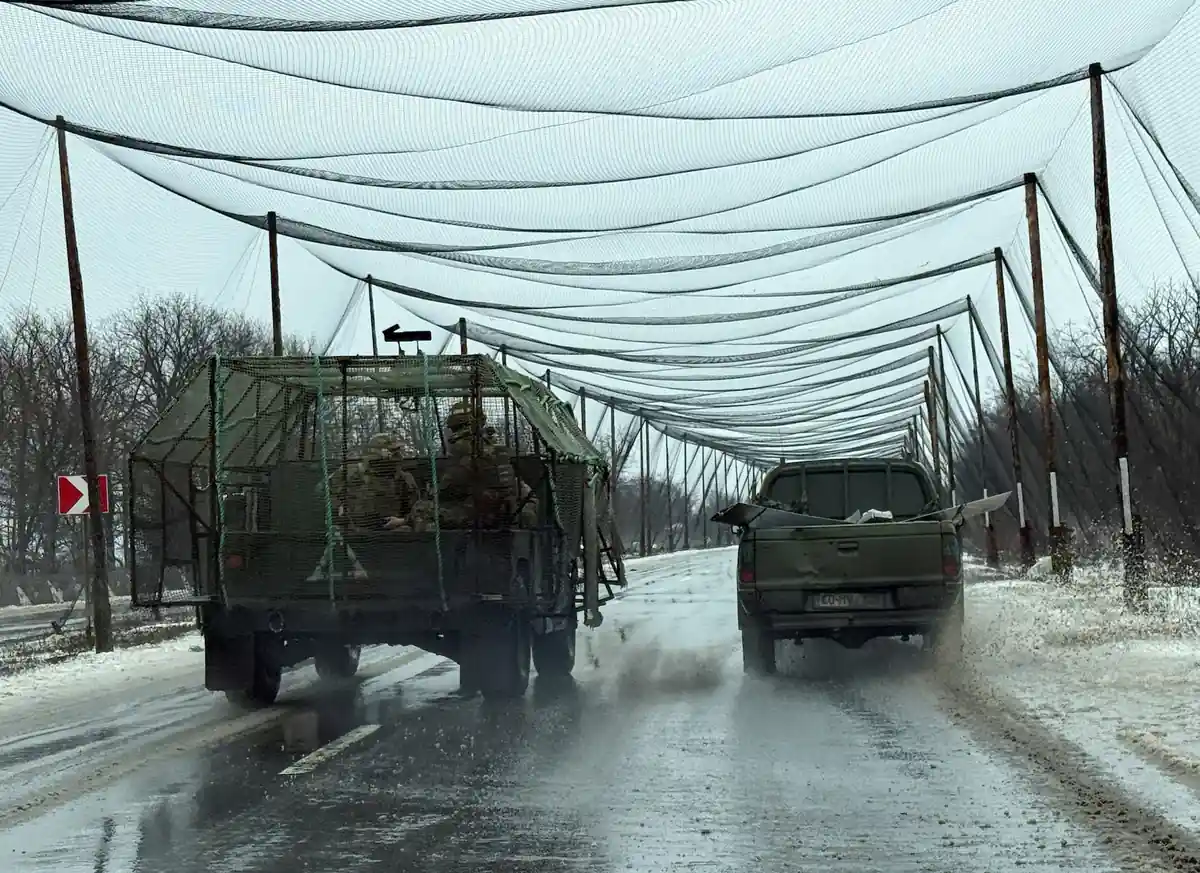
Energy & Infrastructure
Power plants, substations, oil and gas facilities, refineries, communication hubs. Dubai Airport deployed anti-drone cages around fuel tanks in 2026. Non-conductive aramid or HDPE required near electrical assets.
Residential & Property
The fastest-growing application. Homeowners, corporate campuses, and private estates deploying lightweight HDPE netting against surveillance drones and privacy intrusions. HDPE at $2-8/m2 is the practical starting point.
Anti-Drone Net vs Other Counter-Drone Technologies
Anti-drone nets do not exist in isolation. They are one component in a counter-UAS ecosystem that includes detection systems, electronic warfare, and kinetic interceptors. Understanding where nets are superior — and where they need backup — is essential for allocating budget across a layered defense architecture.
| Technology | How It Works | Best For | Weakness | Cost |
|---|---|---|---|---|
| Anti-Drone Net | Passive physical barrier; rotor entanglement or kinetic energy absorption | 24/7 area protection, no operator, immune to electronic countermeasures | Fixed coverage area; cannot pursue drones; heavy solutions need civil engineering | $$ |
| RF Jammer | Disrupts drone control signal or GPS — drone returns home or lands | Rapid single-drone interception; wide area coverage possible | Ineffective vs autonomous/fiber-optic drones; illegal for civilian use; RF interference with other equipment | $$$ |
| GNSS Spoofer | Broadcasts fake GPS signals to redirect drone to safe landing zone | Non-destructive neutralization; handles multiple drones in coverage area | Ineffective vs non-GPS drones; interferes with civil aviation and legitimate GPS users; heavily regulated | $$$ |
| Laser / Directed Energy | High-energy beam burns through drone airframe or electronics | Precision at range; minimal collateral damage; scalable to swarms | Line-of-sight only; degraded by weather/fog/smoke; extreme cost; military-only at operational scale | $$$$$ |
| Interceptor Drone | Dedicated drone with net payload or kinetic ramming capability | Mobile interception at altitude; pursues fleeing drones; longer range than ground launchers | Requires skilled operator; single-target engagement; limited magazine capacity; weather-dependent | $$$ |
The most effective counter-drone architecture — demonstrated at scale in Ukraine — combines electronic detection (radar, RF, EO/IR) for early warning with physical netting as the terminal-phase barrier. Detection identifies the threat; nets provide the always-ready physical layer that catches what electronics cannot stop — especially fiber-optic-guided and autonomous drones, against which jammers and spoofers are completely ineffective.
How to Choose — Buyer Checklist
Use this five-step checklist to arrive at a defensible specification before contacting suppliers. Each step narrows the solution space and prevents the most common procurement mistakes.
-
Step 1 — Define Asset and Threat Profile
What are you protecting, and what drones threaten it? A stationary building needs fixed perimeter or overhead canopy. A moving vehicle needs a vehicle cage or net gun. A supply convoy needs overhead canopy at the halt. Be specific: "DJI Mavic-sized surveillance drones at under 50 meters altitude" is an actionable specification. "Unauthorized drones" is not — it does not drive design decisions.
-
Step 2 — Determine Coverage Geometry
Map approach vectors. If the primary threat comes from the perimeter at low altitude → fixed perimeter barriers. If dive-bombing from above is the main concern → overhead canopy. If the threat direction is unpredictable → combination of perimeter and overhead. Measure total linear meters (perimeter) and square meters (overhead) — these numbers drive your bill of materials and are the first data point any supplier will ask for.
-
Step 3 — Match Material to Environment
Coastal installation? Stainless steel or aramid — galvanized steel degrades to 5-8 year lifespan in salt spray. Desert installation? Stainless steel for permanent; UV-stabilized HDPE for budget-sensitive. Temporary field deployment? Aramid or HDPE for lightweight transport. Urban/industrial moderate conditions? Budget and threat level drive the choice. See complete material specifications →
-
Step 4 — Verify Supplier Certifications
ISO 9001:2015 is the baseline — verify the certificate number against the issuing body registry (UKAS, ANAB, DAkkS). For EU deployments, CE certification is mandatory. For defense procurement, request material test reports: ISO 2307 for tensile strength, ASTM G154 for UV aging. A legitimate manufacturer provides these documents during the RFQ process. A supplier who claims certification but cannot produce verifiable certificate numbers when asked is a procurement risk.
-
Step 5 — Budget Total Cost, Not Material Cost
Material is typically 30-50% of total installed cost for fixed perimeter solutions. Poles, foundations, tensioning hardware, installation labor, and shipping are the other 50-70%. For lightweight aramid solutions (280 g/m2), installation cost approaches 0.5-1x material cost. For heavyweight steel (4.5 kg/m2), installation cost is 2-3x material cost. Factory-direct purchasing from ISO 9001 manufacturers typically yields 20-40% cost reduction versus distributors for projects above 2,000 m2.
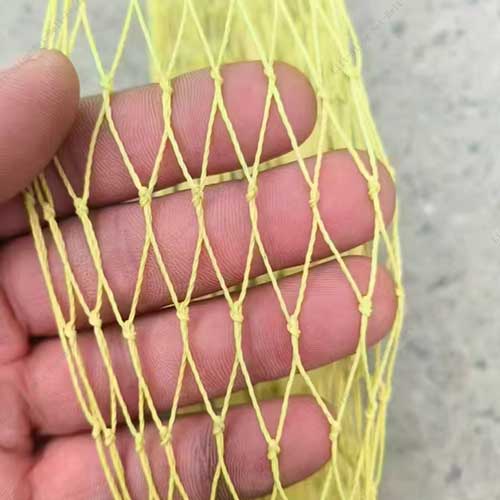
How to Buy: RFQ Process, Lead Times & What to Ask Suppliers
Procuring anti-drone netting is not like ordering standard construction materials. Most solutions are manufactured to order based on site-specific dimensions, threat profiles, and environmental conditions. Understanding the procurement workflow prevents delays, budget overruns, and specification mismatches.
| Stage | Timeline | What Happens | What You Need |
|---|---|---|---|
| 1. Inquiry & Spec | 1-3 days | Send site dimensions, threat profile, preferred material, and budget range. Supplier provides preliminary technical proposal and budget estimate. | Site plan with measurements; drone threat description (type, speed, altitude); environmental conditions; installation constraints |
| 2. Technical Review | 3-7 days | Supplier engineering team validates feasibility, calculates wind load, specifies pole spacing, foundation depth, and tensioning requirements. May request site visit or additional photos. | Soil/ground conditions; wind zone data; existing structure load ratings (if retrofitting) |
| 3. Formal Quotation | 2-5 days | Detailed line-item quote: net material, poles, foundations, tensioning hardware, installation labor (optional), shipping, export documentation. | Review against budget; verify all line items match technical proposal; check lead time commitment |
| 4. Manufacturing | 2-6 weeks | Custom nets fabricated to specification. Standard sizes ship faster; custom dimensions and non-standard mesh patterns add 1-3 weeks. ISO 9001 QC inspection before packing. | Deposit payment (typically 30-50%); confirm shipping method and Incoterms |
| 5. Shipping & Delivery | 1-6 weeks | Sea freight: 3-6 weeks. Air freight: 3-7 days. Factory-direct manufacturers handle export documentation, customs clearance, and door-to-door logistics. | Import license if required; customs broker contact; delivery site access confirmation |
| 6. Installation | 3 days - 6 weeks | Depends on solution type and contractor. Lightweight nets (aramid, HDPE): 3-10 days for 1,000m. Heavy steel nets: 2-6 weeks with civil engineering. | Installation contractor engaged; site preparation complete; access for heavy equipment if needed |
(1) "Can you provide your ISO 9001 certificate number for verification?" (2) "Do you manufacture in your own facility or source from third parties?" (3) "Can you provide ISO 2307 tensile test reports for the specific material batch?" (4) "What is your warranty period and what does it cover?" (5) "Can you provide references from similar projects in our region or sector?" A legitimate manufacturer answers all five within 24 hours. Evasion on questions 2 or 3 is a procurement red flag.
Cost Factors by Solution Type
Cost varies dramatically across solution types. The table below provides order-of-magnitude ranges for initial budgeting. Actual quotes depend on site-specific dimensions, threat profile, material selection, and order volume.
| Solution Type | Material (per unit) | Installation Multiplier | Total Project (typical) | Service Life |
|---|---|---|---|---|
| Fixed Perimeter | $8-60/m2 (by material) | 0.5x (aramid) to 3x (steel) | $50,000-500,000+ for 1,000m | 5-25 years |
| Net Gun / Launcher | $2,000-15,000 per unit | Minimal — training only | $10,000-50,000 for squad kit | 3-5 years (consumable nets) |
| Overhead Canopy | $2-35/m2 (by material) | 0.3x-1x material | $20,000-200,000 for 1,000m2 | 5-12 (HDPE); 15-25 (steel frames) |
| Vehicle Cage | $500-5,000 per vehicle | Workshop labor | $2,000-20,000 per fleet | 6-24 months (combat replacement) |
Maintenance & Lifecycle Management
Anti-drone netting is not "install and forget." Different materials and deployment types require different inspection schedules and maintenance protocols. Planning for maintenance during procurement prevents operational surprises and extends service life.
| Material / Type | Inspection Frequency | Common Failure Modes | Maintenance Actions | Replacement Trigger |
|---|---|---|---|---|
| Aramid (fixed, coated) | Monthly visual; quarterly tensile spot-check | Coating delamination; UV embrittlement at fold points; abrasion at pole attachments | Re-coat UV protection every 3-5 years; replace worn edge reinforcements; re-tension after storms | 15% tensile strength loss from baseline or visible coating failure on >10% of surface |
| Stainless Steel 304/316 | Quarterly visual; annual full inspection | Wire rope fraying at connection points; isolated pitting in 304 grade in marine environments; tension loss over time | Re-tension annually; replace damaged wire rope sections; upgrade 304 to 316 if pitting observed | Wire rope diameter reduction >10% or >3 broken strands per connection point |
| HDPE (UV-stabilized) | Monthly visual; bi-annual tensile test | UV degradation causing surface chalking and brittleness; knot slippage at high-tension points; wildlife damage (birds, rodents) | Replace sections showing surface chalking; re-knot or replace slipped connections; patch wildlife damage within 30 days | Visible surface chalking on >20% of area or tensile below 70% of original spec |
| Galvanized Steel | Monthly in coastal; quarterly inland | Zinc coating consumption leading to red rust; weld point corrosion; tension wire fatigue | Spot-treat rust with cold galvanizing spray; replace severely corroded sections; re-tension annually | Red rust on >5% of surface area or structural thinning visible at connection points |
| Net Gun Cartridges | Pre-mission check; quarterly shelf inspection | Seal degradation on stored cartridges; net folding memory causing incomplete deployment; propellant aging | Rotate stock (first-in-first-out); inspect seals quarterly; replace cartridges at expiration date regardless of condition | Expiration date reached or seal integrity compromised (moisture ingress visible) |
After a net successfully intercepts a drone, conduct an immediate inspection of the impact zone. Even if the net appears intact, the fibers at the impact point may have experienced plastic deformation that reduces their load-bearing capacity. Mark the impact location, photograph it for the maintenance log, and schedule replacement of the affected panel section — do not rely on visual inspection alone. For nets that intercepted drones carrying explosive payloads, replace the entire affected panel and inspect adjacent panels for blast damage.
Installation Complexity
Installation is the hidden cost driver in anti-drone net procurement. A solution that looks economical on a per-square-meter material basis can become prohibitively expensive when foundation engineering, specialized labor, and equipment rental are factored in.
| Solution | Time (1,000m/m2) | Skill Required | Equipment | DIY Feasible? |
|---|---|---|---|---|
| Fixed Perimeter (steel) | 2-6 weeks | Civil engineering, foundation pouring, tensioning | Excavator, concrete mixer, crane | No |
| Fixed Perimeter (aramid/HDPE) | 3-10 days | Basic construction — pole setting, net hanging | Post digger, hand tools, ladder | Possible with guidance |
| Net Gun | Seconds (ready to fire) | Operator training — 1-2 day course | Launcher unit only | No (regulated equipment) |
| Overhead Canopy | 1-5 days | Rigging, cable tensioning, working at height | Lift or scaffold, cable tools | Possible with planning |
| Vehicle Cage | 2-8 hours per vehicle | Welding or mechanical fitting | Welder, vehicle lift | No (military workshop) |
Integration with Detection & Security Systems
Anti-drone nets reach their full potential when integrated into a broader security architecture. A net is the terminal physical layer — but it works best when detection systems tell you a drone is approaching, and when your security operations center can coordinate the response.
Detection Layer Integration
Radar, RF scanners, and EO/IR cameras provide early warning — typically 1-5 km detection range depending on drone size. When a detection system identifies an approaching drone, security personnel can verify whether the approach vector intersects with the net-protected perimeter. This is particularly valuable for net guns and rapid-response teams who need targeting data. For fixed installations, detection data feeds into the security operations center for situational awareness — the net provides the passive barrier while detection provides the active monitoring layer.
Access Control & Patrol Coordination
Fixed perimeter nets with gates and access points must integrate with existing facility access control. Designate net-protected entry/exit lanes with clearly marked passage procedures. For facilities with patrol vehicles or guard tours, ensure the net installation does not create dead zones where guards cannot observe or respond. In prison applications, nets should complement — not obstruct — existing perimeter detection systems like microwave sensors, buried cable detection, and camera analytics.
Electronic Warfare Coordination
In military applications, vehicle cages and fixed nets operate alongside electronic warfare (EW) systems. Critical coordination requirement: some EW systems use omnidirectional jamming that can interfere with friendly communications and navigation. Nets provide a non-emitting defense layer that operates independently of the electromagnetic spectrum — making them valuable in environments where EW is restricted or where electronic silence is required. Do not place net structures in a position that blocks the line-of-sight of directional jammers or radar antennas.
CCTV & Lighting Compatibility
Overhead canopy nets and high fixed barriers can cast shadows that affect camera coverage and site lighting. During the site survey phase, map camera fields of view and lighting coverage against the proposed net installation. Adjust camera mounting heights or net panel positioning to eliminate blind spots. For night operations, ensure nets do not obstruct infrared illuminators — some synthetic net materials are partially transparent to IR, while metal nets can create reflections that confuse thermal cameras. Test with the actual equipment before finalizing the installation plan.
For military applications, the integration of nets with multispectral camouflage is a growing area of operational development. Nets deployed over vehicles and positions can serve double duty — physical drone defense combined with visual, thermal, and radar signature reduction. Modern multispectral camouflage netting systems weighing under 300 g/m2 can be tensioned over anti-drone net support frames, providing both passive drone protection and concealment in a single structure. This dual-purpose approach is particularly cost-effective for artillery positions and supply depots that are stationary for extended periods.
Certifications to Look For
Certifications are the primary mechanism for verifying that a supplier's material and performance claims are backed by audited processes. The defense procurement space attracts suppliers who claim certifications they cannot substantiate. Here is what to verify.
| Standard | What It Covers | How to Verify |
|---|---|---|
| ISO 9001:2015 | Quality management system — consistent manufacturing, documented QC, continuous improvement | Request certificate number. Verify against issuing body registry (UKAS, ANAB, DAkkS). Do not accept a logo without a verifiable number. |
| CE | European conformity — safety, health, environmental requirements for EEA | Mandatory for EU/EEA deployment. Request Declaration of Conformity with notified body number. |
| ISO 2307 | Fiber rope tensile — standardized breaking strength and elongation measurement | When a supplier claims "3,500 N per strand," request the test report showing ISO 2307 methodology. In-house testing without this standard is not comparable across suppliers. |
| ASTM G154 | Accelerated UV weathering — quantifies material degradation under simulated sunlight | For HDPE nets, 3,000+ hours certification = 5-12 year outdoor UV resistance. Request the actual test report with cycle parameters — not just the hours number. |
(1) Certification logos without certificate numbers. (2) Claims of "ISO certified" without specifying which standard. (3) Cannot produce test reports when asked. (4) Claims to be a manufacturer but outsources production to multiple factories. Factory-direct manufacturers with vertically integrated production consistently deliver stronger quality documentation than multi-source trading companies.
DIY vs Engineered Anti-Drone Nets
The Ukraine conflict has demonstrated that improvised netting — construction debris mesh, fishing nets, pigeon control netting, even camouflage nets — can and does stop drones. The question is not whether DIY nets work at all. The question is: in what scenarios is the risk of failure acceptable, and when must you invest in engineered solutions?
When DIY Is Acceptable
- Emergency/temporary deployment — the alternative is no protection at all
- Low-threat environment — consumer camera drones, not weaponized FPVs
- Short duration — under 6 months before UV degradation becomes critical
- Non-critical asset — failure does not result in loss of life or catastrophic damage
- Combat iteration — units who replace nets weekly as they get damaged in active combat
When You Need Engineered Nets
- Permanent installation — nets must survive years of UV, wind, rain, and temperature cycling
- High-threat environment — weaponized FPVs, Lancet-class loitering munitions, military drones
- Critical asset protection — airports, power plants, military bases, government facilities
- Liability exposure — failure of the net could result in legal or regulatory consequences
- Specification compliance — government or military procurement requires certified materials
DIY nets fail in three predictable ways: (1) unpredictable tensile strength — construction mesh rated for debris, not high-velocity impact, tears on drone strike; (2) rapid UV degradation — unrated materials lose 50%+ of tensile strength within 6-12 months outdoors; (3) inconsistent mesh aperture — fishing nets and pigeon nets have variable hole sizes that allow small drones to pass through undetected.
For the dismounted infantry squad, a 50 mm pigeon control net weighing 150 grams per 3m x 2m panel — costing less than a single mortar round — is an entirely rational choice. For the airport perimeter protecting hundreds of thousands of passenger lives, an engineered stainless steel wire rope net with ISO 9001 traceability, CE certification, and 15-25 year design life is the only defensible choice. The key is matching the solution to the consequence of failure.
Frequently Asked Questions
Lightweight HDPE netting (180-350 g/m2, 40x40mm mesh) is the most practical starting point for residential and small commercial property protection. It is the most affordable material, mounts on existing fences or building facades, and provides adequate interception for consumer camera drones. Material cost: $2-8/m2. Complete DIY installation: $500-2,000. Professional installation: $3,000-10,000. Important: Check local building codes and HOA rules before installing permanent structures. Temporary, non-permanent netting typically faces fewer regulatory barriers.
Yes — with clear qualification by drone class. Group 1-2 (under 25 kg, exposed rotors): 85%+ field-observed interception rate. Group 3 (25-150 kg, Lancet/ScanEagle class): 70-85% with specialized multi-layer netting incorporating sacrificial energy-absorption layers. Group 4-5 (Predator/Reaper, 150+ kg): not a standalone solution — these operate at altitudes and speeds exceeding net-based system envelopes. The critical variable is rotor exposure, not airframe mass: any drone with unshielded propellers is vulnerable to entanglement regardless of size. Fixed-wing and ducted-fan designs are more challenging to intercept.
An anti-drone net gun is a handheld or vehicle-mounted launcher that fires a compressed-air or pyrotechnic-propelled net projectile to capture individual drones at ranges of 10-100 meters. Systems like SkyWall and DroneGun are commercially available. Regulatory note: Net guns are typically classified as law enforcement or military equipment subject to export controls and end-user restrictions. Civilian purchase is heavily restricted or prohibited in most jurisdictions. For government, law enforcement, or military procurement, contact manufacturers through formal RFQ processes. DroneXNet specializes in fixed perimeter and overhead canopy netting solutions.
Cost varies by solution type, material, area, and installation complexity. Fixed perimeter HDPE: $8-20/m2 material only. Aramid: $15-35/m2. Stainless steel: $25-60/m2. Overhead canopy: $2-35/m2 material. Net gun launcher: $2,000-15,000 per unit. Vehicle cage: $500-5,000 per vehicle. Installation typically adds 50-300% to material cost depending on solution weight and foundation requirements. Volume discounts begin at approximately 1,000 m2 for fixed solutions. Request a formal factory-direct quote with your site dimensions and threat profile for accurate pricing.
Generally yes, subject to local building codes, homeowners association rules, and aviation regulations. Key considerations: (1) Structure height — permanent poles above certain heights (typically 2-4 meters depending on jurisdiction) may require building permits. (2) Proximity to airports — installations near airports may require aviation authority notification. (3) Visual impact — some jurisdictions regulate visible structures. (4) You cannot actively intercept or disable drones — passive barriers are legal; active jamming or kinetic interception is regulated. Consult local authorities before installing permanent structures.
Anti-drone netting refers to the mesh material itself — the fabric, wire rope, or fiber panel. Anti-drone fence refers to a complete turnkey system: netting + poles + foundations + tensioning hardware + installation. When buying, specify whether you need material only or a complete system. Complete systems cost more upfront but eliminate component mismatch and installation risk. See our materials guide and fence system specs.
Get Your Anti-Drone Net Solution Specification
Fixed perimeter barriers, overhead canopy systems, and custom vehicle protection netting. Aramid, stainless steel, HDPE, and galvanized steel options available. ISO 9001:2015 certified manufacturing with global logistics to 30+ countries. Provide your site specifications for a technical proposal and formal quotation within 24 hours.
Related resources: netting materials guide · aramid net specs · military deployments · prison solutions