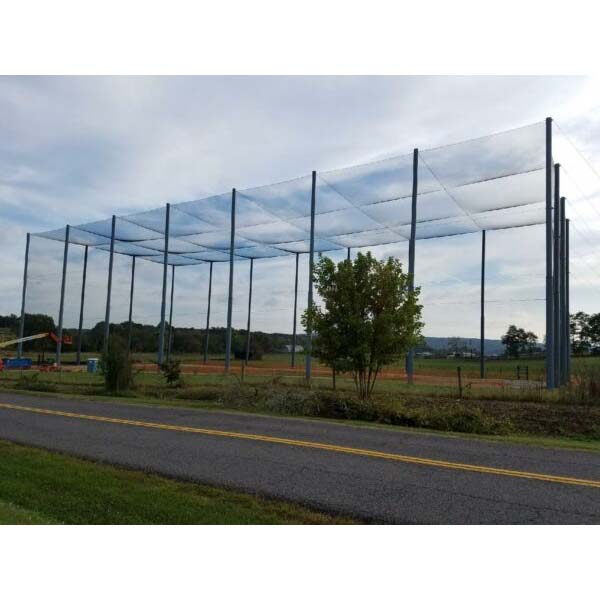
In 2026, Ukraine is installing 12 kilometers of anti-drone netting every single day along front-line supply routes. That is not a pilot program or a field trial — it is one of the largest rapid-deployment physical defense operations in modern military history. The reason is brutally simple: FPV drones are now responsible for up to 80% of front-line casualties, and nets stop them when electronic countermeasures fail.
Yet for procurement officers and security engineers evaluating anti-drone netting, the commercial information landscape has a glaring hole. Most product pages offer marketing copy without specifications. Most guides talk about nets in theory without real material data. And virtually no public resource answers the question everyone asks first: what does anti-drone netting actually cost, and what drives that cost?
This guide closes that gap. You will find engineering specifications for all four major netting materials, a deployment architecture comparison, a structured selection framework you can use in technical review meetings, and a transparent breakdown of the cost factors that determine your final procurement budget. All data comes from ISO 9001:2015 certified manufacturing — not marketing estimates.
What Is Anti-Drone Netting?
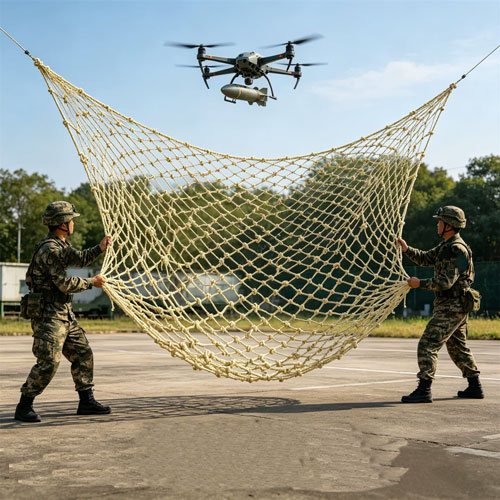
Anti-drone netting is an engineered physical barrier system designed to intercept, entangle, and neutralize unmanned aerial vehicles (UAVs) before they reach a protected asset. Unlike electronic counter-UAS (C-UAS) technologies — jammers, spoofers, directed-energy weapons — netting does not rely on radio frequency detection, signal disruption, or operator intervention. It is a passive, always-ready physical defense layer that works on pure kinetic principles: a drone flies into the net, its rotors catch the mesh fibers, and within milliseconds the aircraft loses controlled flight.
The technology spans a wide range of applications. At one end, lightweight aramid nets weighing under 300 grams per square meter drape over military vehicles and temporary field positions. At the other, stainless steel wire rope nets with tensile strengths exceeding 1,800 N/mm2 form permanent perimeter barriers around airports, power plants, and border installations.
Anti-drone netting is not fishing net, construction debris netting, or agricultural mesh. Engineered anti-drone nets use high-tenacity fibers and steel alloys tested to specific tensile, UV, and impact standards. Makeshift nets tear under repeated impact and degrade within months. This guide covers only purpose-built, specification-grade netting.
How Anti-Drone Netting Works — The Physical Interception Principle
The interception mechanism behind anti-drone netting is deceptively simple in concept but demands precise engineering in execution. Here is the three-stage physics:
-
Stage 1 — Impact & Energy Transfer
When a drone strikes the net at velocity, the mesh fibers absorb kinetic energy through elastic deformation. Aramid fibers elongate 3.5-4.5% before yield; steel wire rope approximately 1.5-2.5%. This elasticity prevents the net from behaving like a rigid wall — it conforms around the airframe instead of ricocheting the drone or snapping. Energy absorption capacity depends on material modulus, mesh geometry, and boundary fixation method.
-
Stage 2 — Rotor Entanglement
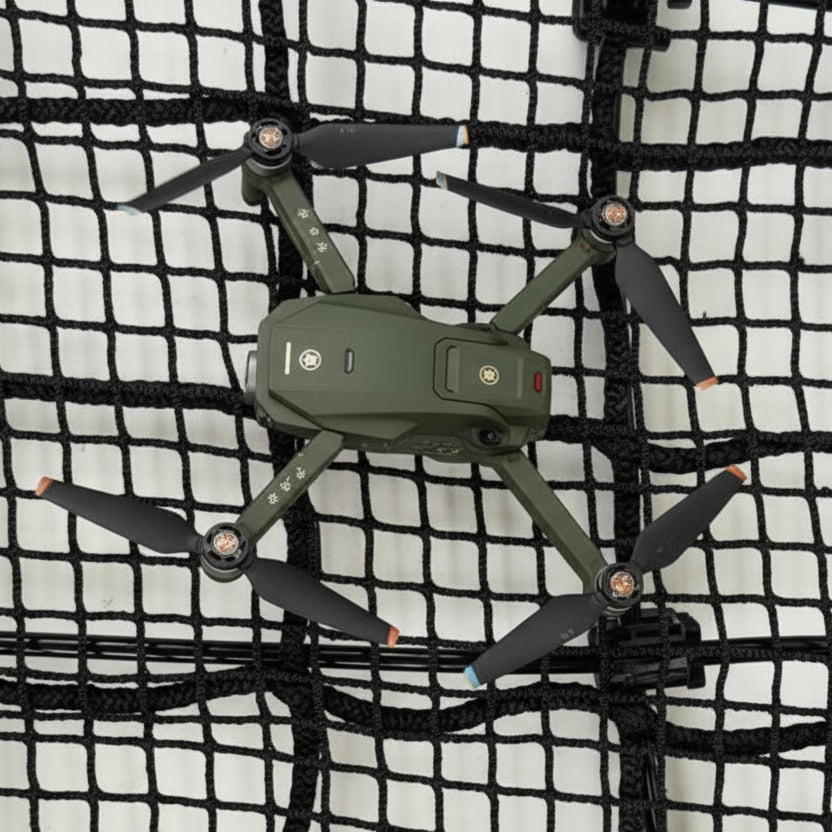
The critical failure mode. As the net drapes over the drone, exposed rotor blades catch mesh strands. At 5,000-12,000 RPM, fibers wrap around the motor shaft within 2-5 rotations — under 0.1 seconds. This creates a self-tightening entanglement loop: the harder the motors fight, the tighter the fibers cinch. The drone loses thrust instantly. Field testing shows entanglement probability exceeds 95% on first contact for exposed-rotor designs.
-
Stage 3 — Controlled Descent or Containment
Once entangled, the drone either descends under gravity or remains suspended in the netting for later recovery. Engineering calculations apply a safety factor of 3:1 to 5:1 over maximum expected drone mass. Some systems incorporate sacrificial layers that tear to absorb extreme kinetic energy, while the primary barrier behind maintains structural integrity.
A net does not need to be stronger than the drone. It only needs to be stronger than the drone rotor shaft bearings — and once those are jammed, the drone is aerodynamically dead regardless of motor power.
Anti-Drone Netting Materials Compared
The choice of netting material is the single most consequential decision in any anti-drone netting procurement. Four primary materials dominate the market — each with fundamentally different strength, weight, durability, and cost profiles.
| Specification | Aramid Fiber | Stainless 304 | HDPE | Galvanized |
|---|---|---|---|---|
| Material | Para-Aramid 1414 | AISI 304 wire rope | UV-stabilized HDPE | HDG carbon steel |
| Tensile | 3,500 N/strand | 1,800 N/mm2 | 35 kN/m | 1,500 N/mm2 |
| Mesh | 25 x 25 mm | 50 x 50 mm | 40 x 40 mm | 50 x 50 mm |
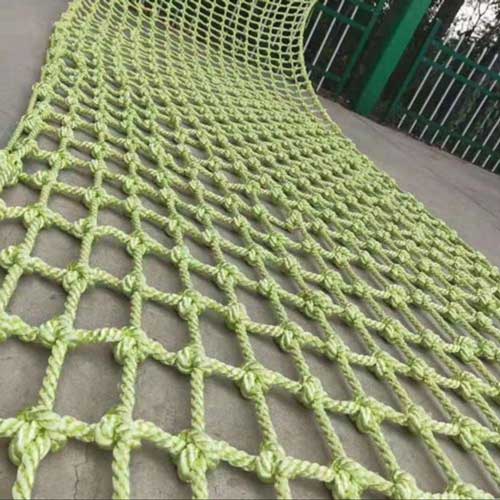
| Weight | 280 g/m2 | 4.5 kg/m2 | 180-350 g/m2 | 1.0-2.0 kg/m2 |
| Temp Range | -50 to +150C | -40 to +300C | -20 to +80C | -30 to +200C |
All specs verified from ISO 9001:2015 certified manufacturing data.
Performance Ratings — Visual Comparison
| Attribute | Aramid | Stainless | HDPE | Galvanized |
|---|---|---|---|---|
| Tensile Strength | Excellent 90% | Best 100% | Low 20% | Good 75% |
| Weather Resistance | Moderate 45% | Best 100% | Good 55% | Moderate 40% |
| Cutting Resistance | High 85% | Best 100% | Low 25% | High 90% |
| Weight Efficiency | Best 100% | Heaviest 15% | Excellent 95% | Heavy 30% |
| Cost-Effectiveness | Premium 45% | Most Expensive 15% | Best Value 100% | Good Value 65% |
Why Mesh Aperture Is the Most Overlooked Specification
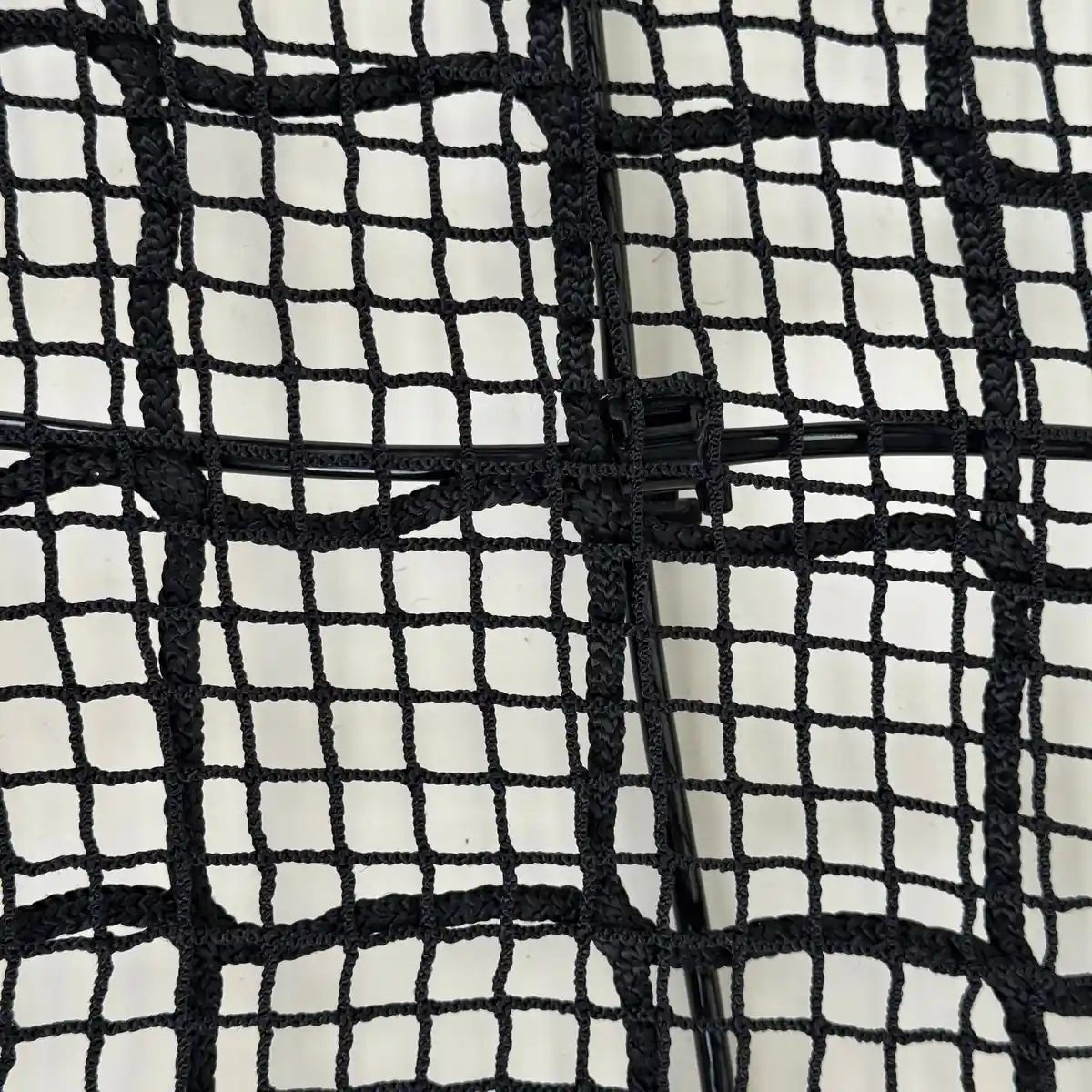
Mesh aperture — the size of each square opening in the net — determines whether a drone passes through, gets caught, or bounces off. The physics is straightforward but procurement documents rarely account for it:
Too Large (>60 mm)
Small drones (DJI Mini, ~180 mm diagonal) slip through mesh squares. Larger drones may pass at oblique angles.
Optimal (25-50 mm)
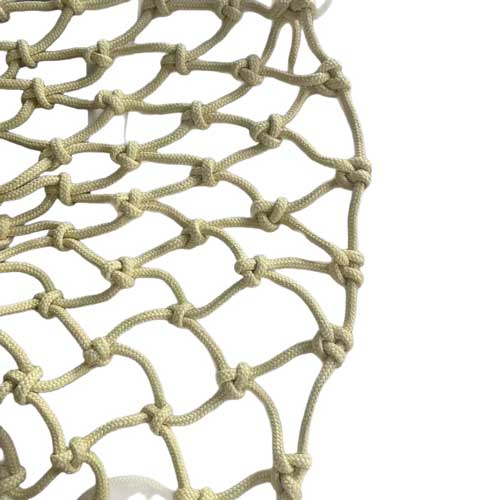
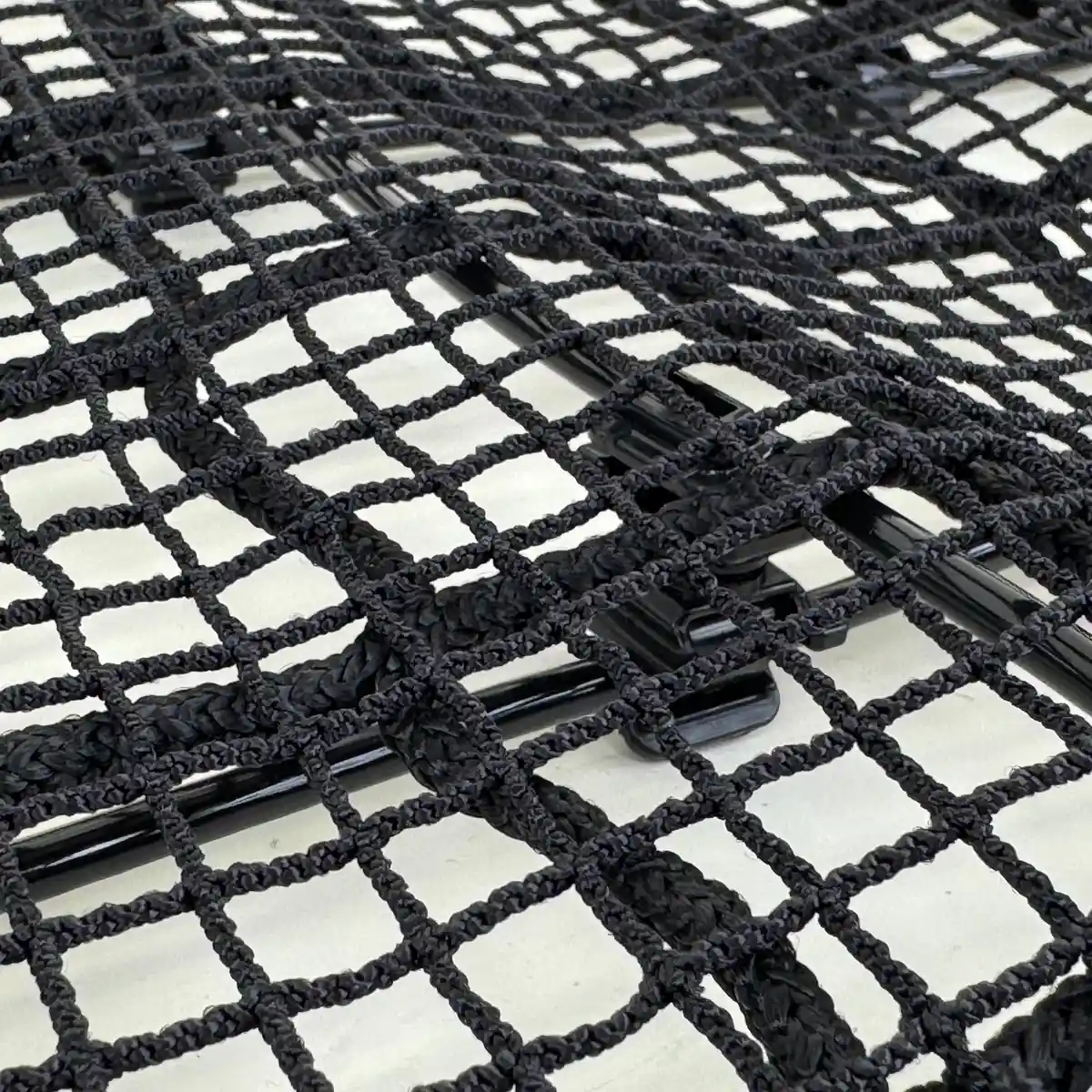
Catches rotor arms and propeller tips regardless of drone orientation. The 25x25 mm aramid net captures the smallest FPV drones.
Too Small (<15 mm)
3x filament density = heavier poles, deeper foundations, higher wind load. No proportional capture improvement.
For most fixed installations, 50 x 50 mm strikes the practical balance. The aramid anti-drone net at 25 x 25 mm is the specification choice when the threat includes micro-UAVs below 250 grams.
Types of Anti-Drone Netting Deployments
Anti-drone netting spans four distinct deployment architectures, each with different engineering requirements and cost structures.
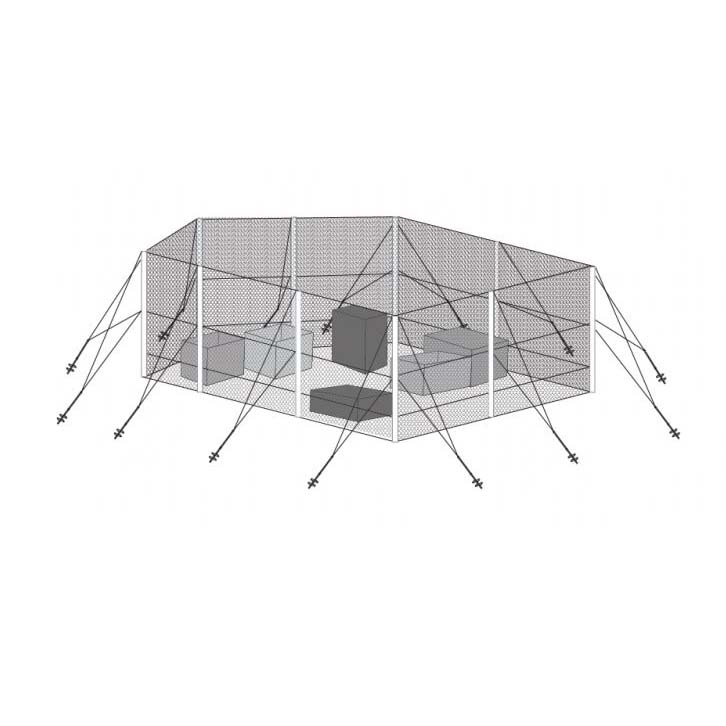
Fixed Perimeter Barriers
Vertical net panels suspended between steel or concrete poles. Panel heights 4-12 meters. Requires engineered foundations rated for regional wind loads. Pole spacing 5-10 meters.
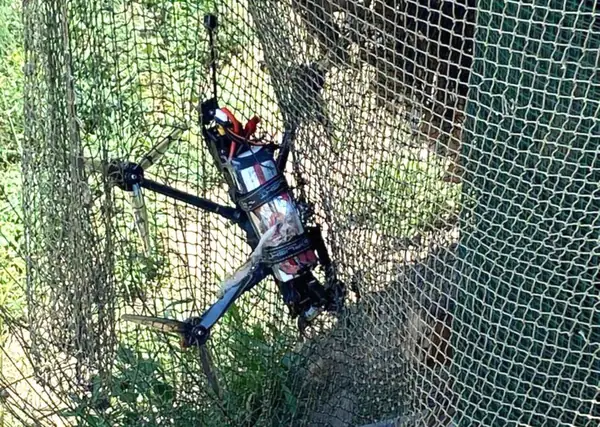
Overhead Canopy Systems
Horizontal or sloped netting suspended above roads, courtyards, and rooftops. Most visible in Ukraine where entire streets run through netting tunnels. Wind uplift is the dominant structural concern.
Vehicle-Mounted Netting
Net panels welded or bolted onto military vehicles — the "cope cage" architecture from the Russo-Ukrainian war. Effectiveness depends on standoff distance from the hull to cause premature warhead detonation.
Handheld Launched Nets
Compressed-air or pyrotechnic-launched nets for individual drone capture at 10-100 meter range. Active interception requiring detection and targeting. Entire projectile must stay under 500 grams.
For permanent site protection, the anti-drone fence system combines fixed perimeter barriers with integrated mounting hardware and tensioning systems.
How to Choose Anti-Drone Netting — A 4-Step Selection Framework
The most common procurement mistake is starting with material selection. Material choice is an output of threat-and-environment analysis, not an input. Use this framework to arrive at a defensible specification before requesting quotes.
-
Step 1 — Define Your Threat Profile
Consumer 0.5-2kg HDPE or lightweight aramid. Mesh ≤50 mm.
FPV Attack 1-5kg Aramid minimum. Mesh ≤40 mm. These drones carry payloads at 100+ km/h.
Military 50-200+kg Stainless steel or multi-layer aramid with sacrificial layers and blast mitigation. -
Step 2 — Assess Your Environment
Coastal AISI 316 stainless or aramid. Galvanized steel degrades in 5-8 years here.
Desert/UV Stainless for permanent. UV-stabilized HDPE or coated aramid for 5-12yr deployments.
Temporary Aramid or HDPE. Weight and packability over extreme durability. -
Step 3 — Calculate Structural Constraints
Net weight drives pole sizing and foundation depth.
Stainless steel at 4.5 kg/m2 = heavy foundations, installation 2-3x material cost.
Aramid at 280 g/m2 = can mount on existing structures, installation 0.5-1x material cost. -
Step 4 — Analyze Total Cost of Ownership
Look beyond per-m2 material price. Stainless steel: highest upfront but 15-25yr zero-maintenance makes it lowest TCO over a 20-year planning horizon. HDPE: lowest upfront but 5-12yr replacement cycle drives up long-term cost.
Anti-Drone Netting Cost Factors — What Drives Your Budget
Anti-drone netting cost is driven by five variables. Understanding them lets you build an accurate internal budget — and identify where specifications can be adjusted without compromising security.
| Cost Driver | Impact | How to Optimize |
|---|---|---|
| Material | Largest single variable. HDPE : galvanized : aramid : stainless ≈ 1:2:5:8 cost ratio. Match material to actual threat — do not over-specify. | |
| Coverage Area | Linear cost. Volume discounts begin at 1,000 m2; significant above 5,000 m2. Pole/foundation costs scale sub-linearly. | |
| Poles & Foundation | Heavy steel nets require engineered foundations equal to material cost. Lightweight nets reduce this by 50-70% using standard poles or existing structures. | |
| Custom Finishing | Standard panels (10x10 m, 2x3 m) most economical. Custom dimensions, reinforced edges, grommets add 15-30%. | |
| Shipping & Logistics | Aramid (0.28 kg/m2) ships 16x the coverage of steel (4.5 kg/m2) in the same container. For overseas projects, this can flip the total project economics. |
Factory-direct from ISO 9001 manufacturers typically yields 20-40% cost reduction versus distributors. Lead time trade-off: 4-8 weeks custom vs 1-2 weeks stocked. For projects above 2,000 m2, factory-direct is virtually always the economically superior route.
Anti-Drone Netting vs Electronic C-UAS — When Physical Defense Wins
The procurement debate between nets and electronic countermeasures is not binary. The best architectures combine both. But in specific scenarios, netting is objectively superior:
| Scenario | Netting | Electronic C-UAS |
|---|---|---|
| Fiber-optic guided (unjammable) | Effective | Ineffective |
| Autonomous pre-programmed | Effective | Ineffective |
| Drone swarm (5+ targets) | Partial | Partial |
| GPS-denied environments | No dependency | Spoofers fail |
| 24/7 continuous, no operator | Always active | Needs power/ops |
| High-speed fixed-wing 150+ km/h | Needs multi-layer | Tracking challenge |
Reality: Use detection systems (radar, RF, EO/IR) to identify threats. Use netting as the terminal-phase physical barrier. Ukraine has demonstrated this layered approach — electronic detection + physical interception — produces the highest overall protection probability.
Real-World Anti-Drone Netting Deployments
Ukraine Street Canopy
Government plans 2,500 miles of drone netting over supply routes by end of 2026. Teams deploy ~12 km/day. The largest rapid-deployment netting operation in history.
Dubai Intl Airport
May 2026: fuel tank anti-drone cages deployed. First major Middle East civil aviation critical infrastructure netting protection installation.
Vehicle Armor Programs
UK, Japan, India, China all trialing or deploying anti-drone netting on main battle tanks. Improvised modification → formal procurement specification.
Certifications & Standards for Anti-Drone Netting
Certifications are the primary mechanism for verifying that material claims are backed by audited manufacturing and independent testing.
| Standard | What It Covers | Procurement Action |
|---|---|---|
| ISO 9001:2015 | Quality management system — consistent manufacturing, documented QC, continuous improvement | Baseline for any defense procurement. Ask for certificate number; verify against issuing body registry. Do not accept logo alone. |
| CE | European conformity — safety, health, environmental requirements | Required for EU/EEA deployment. Increasingly requested by non-EU buyers as quality proxy. |
| NATO STANAG | Standardization agreements for NATO forces | Reference framework for military procurement. Material testing, durability, ballistic protection levels. |
| ASTM G154 | Accelerated UV weathering — material degradation under simulated sunlight | HDPE nets with 3,000+ hrs certification = 5-12yr outdoor UV resistance. Request the test report. |
| ISO 2307 | Fiber rope tensile — breaking strength and elongation | Verify "3,500 N per strand" claims follow ISO 2307 methodology, not in-house testing. |
Factory-direct manufacturers with vertically integrated production typically have stronger quality documentation than trading companies. When evaluating suppliers, compare the depth of test reports they can provide — not just the logos on their website.
Frequently Asked Questions
Material-only ranges: HDPE $2-8/m2, galvanized steel $8-20/m2, aramid $15-35/m2, stainless steel $25-60/m2 — before installation, poles, foundations, and shipping. Actual pricing depends on total area, customization, grade, and volume. Factory-direct with volume above 2,000 m2 yields best pricing. Always request a formal quote with your site dimensions and threat profile.
Yes — for Group 1-2 drones (under 25 kg) with high reliability. Group 3 (25-150 kg, ScanEagle class) requires multi-layer netting with sacrificial layers, 70-85% success. Group 4-5 (Predator/Reaper, 150+ kg) are outside net-based system envelopes. For large military UAVs, nets are part of layered defense, not standalone solution.
Stainless steel: 15-25+ years (AISI 316 marine; 304 inland). UV-coated aramid: 5-10 years. HDPE with stabilizers: 5-12 years. Galvanized steel: 8-15 years inland, 5-8 coastal. Monthly inspections for fixed installations; pre-mission for mobile systems.
Makeshift netting (debris mesh, fishing nets, agricultural netting) works for emergency deployments but fails three ways: (1) unpredictable tensile strength — tears on high-speed impact; (2) rapid UV degradation — 50%+ strength loss in 6-12 months; (3) inconsistent mesh aperture allows pass-through. For temporary protection where the alternative is nothing, DIY has a role. For permanent critical asset protection, only specification-grade engineered netting is defensible from security and liability standpoints.
Thermite drones burn through nylon and HDPE. Aramid is inherently flame-resistant (LOI 29, self-extinguishing). Stainless steel is effectively immune at small-drone-payload temperatures and durations. For environments where incendiary drones are in the threat model: specify aramid or stainless steel — never HDPE or nylon — and reference flame-resistance standards in the procurement contract.
Minimum: ISO 9001:2015 with verifiable certificate number. For EU: CE certification. For defense: ISO 2307 tensile reports, ASTM G154 UV aging reports, ballistic/resistance standards as specified. Legitimate manufacturers provide these during RFQ. Be skeptical of certification logos without corresponding certificate numbers. Factory-direct manufacturers consistently have stronger quality documentation than multi-source trading companies.
Get Your Anti-Drone Netting Specification & Quote
Custom specifications — material, mesh aperture, panel size, edge finishing — manufactured to your exact requirements. Provide your site dimensions and threat profile for a technical specification and formal quotation. Global logistics network delivering to 30+ countries including Middle East, Europe, North America, and Asia-Pacific.
Still evaluating? Read our complete materials comparison guide or explore individual products: aramid anti-drone net, stainless steel drone net, HDPE drone net.