FAQ
Frequently Asked Questions About Anti-Drone Nets
Everything you need to know about anti-drone physical protection nets — materials, installation, maintenance, and compliance for military, government, and critical infrastructure applications.
Browse Questions ↓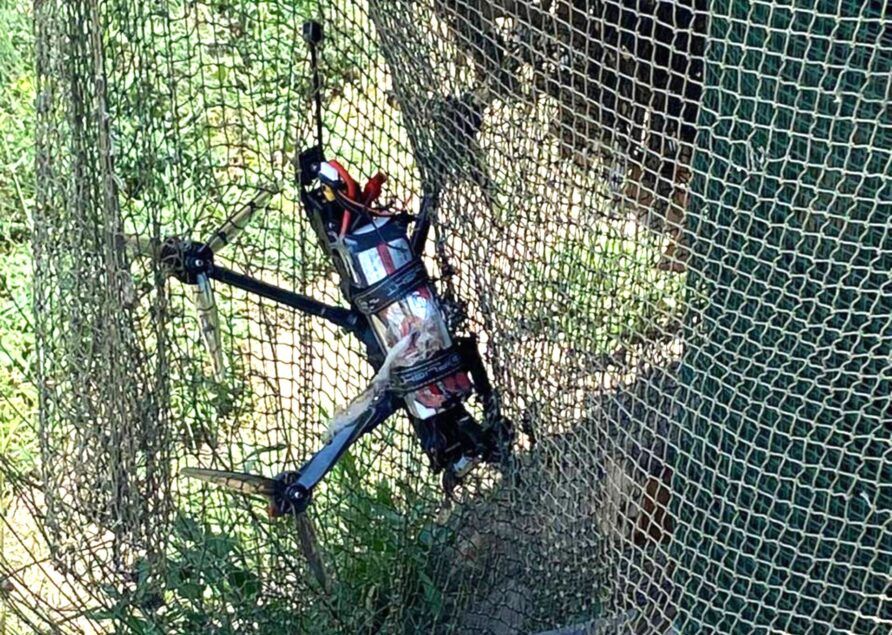
Anti-Drone Net Knowledge Base
C-UAS Comparison
How does an anti-drone net compare to electronic C-UAS systems like jammers or radar-directed interceptors?
Anti-drone nets and electronic C-UAS serve complementary roles in a layered defense strategy. Electronic systems (RF jammers, GNSS spoofers, radar-directed kinetic interceptors) excel at detection, tracking, and soft-kill neutralization at longer ranges. However, they have well-documented limitations: jammers can affect nearby communications equipment, radar has gaps at low altitude and in cluttered environments, and GPS spoofing is increasingly countered by autonomous drone navigation. Anti-drone nets provide a 100% physical hard-kill barrier that cannot be spoofed, jammed, or electronically evaded. A drone that flies into the net is physically captured regardless of its flight mode, autonomy level, or encryption. The most effective C-UAS strategies combine both: electronic detection and tracking at the perimeter, with anti-drone nets as the last line of physical defense.
Compliance & Regulations
Are anti-drone nets compliant with aviation safety regulations (FAA, EASA, ICAO)?
Yes. Anti-drone physical nets are classified as passive protective structures, not active electronic countermeasures, and therefore do not interfere with aircraft communication, navigation, or radar systems. For airport installations, DroneXNet systems are designed to comply with FAA Advisory Circulars and ICAO Annex 14 requirements for obstacle limitation surfaces and frangibility. The nets are mounted at approved heights and distances from runways based on site-specific aeronautical studies. Unlike RF jammers or laser systems which face significant regulatory hurdles (FCC restrictions, spectrum licensing), physical nets face no electronic interference restrictions. However, all permanent overhead installations, especially near airports, should undergo an aeronautical obstacle assessment. DroneXNet provides compliance documentation and works with airport authorities to ensure full regulatory alignment.
Contact & Quoting
How do I request a quote or technical consultation for an anti-drone net system?
You can contact DroneXNet through our website contact form at dronexnet.com/contact/, email us directly at sales@dronexnet.com, or call +86 318 1234 5678. For fastest response, please provide: (1) site dimensions and layout (area to be protected in m²), (2) threat profile (drone types expected, operating altitudes), (3) environmental conditions (wind zone, temperature range, coastal/desert exposure), (4) deployment type (permanent overhead, fence-top, wall-mounted, or temporary), and (5) any regulatory requirements (FAA, EASA, local civil aviation). Our technical team typically responds within 24 hours with preliminary recommendations, material options, estimated pricing, and reference installations for similar applications. Bulk and government procurement inquiries receive priority handling.
Durability & Environment
Can anti-drone nets withstand extreme weather conditions like hurricanes, snow loads, or sandstorms?
Yes, DroneXNet anti-drone nets are engineered for all-weather performance across diverse climatic zones. Stainless steel and galvanized steel nets withstand wind speeds exceeding 200 km/h (Category 5 hurricane) when properly tensioned and anchored, and support heavy snow loads up to 50 kg/m² in overhead configurations. Aramid fiber nets maintain their tensile strength across a temperature range of -40°C to +200°C and resist UV degradation for extended outdoor service life. HDPE nets are treated with UV stabilizers and perform well in coastal and desert environments. All material types are corrosion-resistant (aramid and HDPE are inherently non-corrosive; steel variants use hot-dip galvanizing or 304 stainless steel). For extreme environments, DroneXNet recommends stainless steel or HDG (hot-dip galvanized) steel for maximum longevity, while aramid is preferred for tactical rapid-deployment scenarios where weight is the primary consideration.
Installation & Applications
Where can anti-drone nets be installed?
Anti-drone nets can be installed in virtually any environment where drone threats exist. Typical installation sites include: military bases and forward operating bases (FOBs), international airport perimeters and runway approaches, correctional facilities (prisons) to prevent contraband drone deliveries, national border crossings and sensitive government buildings, critical infrastructure such as power plants, water treatment facilities, and data centers, stadiums and large public event venues, and embassy compounds. Installation configurations include overhead canopy systems (pole-supported nets spanning the protected area), perimeter fence-top extensions, wall-mounted bracket systems, and scaffolding or truss-supported structures for irregular terrain.
Maintenance & Durability
What is the typical lifespan of an anti-drone net and what maintenance is required?
Lifespan varies significantly by material: stainless steel 304 rope mesh nets last 15–20 years with minimal maintenance; galvanized steel nets last 8–12 years depending on environmental conditions; aramid fiber nets last 5–8 years under normal outdoor exposure; and HDPE nets typically last 3–5 years. Regular maintenance includes quarterly visual inspections for tears, loose connections, or structural fatigue (more frequent in high-wind or coastal environments), cleaning of accumulated debris (leaves, bird nests), annual tension adjustment for overhead installations, and replacement of damaged sections. All DroneXNet systems are designed with modular components that allow individual panel replacement without full system teardown, minimizing operational downtime and replacement costs.
Materials & Specifications
What materials are anti-drone nets made from, and which one is right for my site?
DroneXNet offers four primary material types: (1) Aramid fiber — lightweight, ultra-high tensile strength (5x stronger than steel by weight), excellent for military and tactical deployments where portability and rapid installation are critical. (2) Stainless Steel 304 rope mesh — the most durable option with 15–20 year service life, ideal for permanent perimeter installations at airports, prisons, and government facilities. (3) Galvanized steel — cost-effective for large-area coverage with excellent corrosion resistance, suitable for industrial sites and border security. (4) HDPE — lightweight and UV-stabilized, best for temporary deployments or budget-conscious projects. Selection depends on threat level, environmental conditions, deployment duration, and regulatory requirements.
Product Overview
What is an anti-drone net and how does it work?
An anti-drone net is a physical barrier system made from high-strength materials such as aramid fiber, stainless steel rope mesh, or HDPE (high-density polyethylene). It works by intercepting and entangling unauthorized UAVs that fly into or over a protected perimeter. Unlike electronic C-UAS systems that rely on jamming or radar, anti-drone nets provide a passive, fail-safe physical defense — there is no risk of signal interference, electronic countermeasures being bypassed, or collateral damage from kinetic projectiles. The net absorbs the drone's kinetic energy through its flexible weave structure, causing the rotor blades to become entangled and the aircraft to lose lift, falling safely within the capture zone.

Contact Our Anti-Drone Net Specialists
Have a Different Question?
Our technical team can provide tailored recommendations for your specific security requirements. Whether you need specs, pricing, or installation guidance — we're ready to help.
Need a Custom Solution?
We engineer custom anti-drone nets for unique operational environments. Get a quote tailored to your site specifications.
Ask a Question →